
The Crucible Act 1: A Comprehensive Exploration
Act 1’s readily available PDF format enhances accessibility for students and scholars alike, facilitating detailed analysis of Miller’s masterful opening.
It presents the foundational events,
establishing the play’s tense atmosphere and key character introductions.
Historical Context: The Salem Witch Trials
The Salem Witch Trials of 1692, a dark chapter in American history, serve as the chilling backdrop for Arthur Miller’s The Crucible. The trials originated from a deeply religious Puritan community gripped by fear and superstition. Accusations, often fueled by personal vendettas and societal anxieties, quickly spiraled out of control, leading to mass hysteria.
Act 1 vividly reflects this historical context, mirroring the initial accusations and the atmosphere of paranoia that consumed Salem Village. The PDF versions of the play allow for close examination of how Miller meticulously recreates the language and beliefs of the era. The trials began with the strange behavior of young girls, including Abigail Williams, who claimed to be afflicted by witchcraft.
These claims, amplified by religious leaders like Reverend Parris, ignited a wave of accusations against marginalized members of the community. The trials resulted in the imprisonment of over 200 people and the execution of twenty individuals, primarily women. Understanding this historical context is crucial for interpreting the play’s themes of injustice, mass hysteria, and the dangers of unchecked power, readily available within the Act 1 PDF.
The Crucible as an Allegory for McCarthyism
Arthur Miller deliberately crafted The Crucible as a powerful allegory for McCarthyism, the anti-communist “witch hunt” that gripped the United States in the 1950s. The play’s parallels to this period are striking, mirroring the atmosphere of fear, suspicion, and baseless accusations that characterized both eras.
Act 1, accessible in PDF format, immediately establishes this allegorical connection. Just as individuals were pressured to name suspected communists during McCarthyism, characters in Salem are coerced into confessing to witchcraft, often to save themselves. The relentless questioning and the demand for names echo the tactics employed by Senator Joseph McCarthy and the House Un-American Activities Committee.
Miller used the Salem trials to critique the dangers of ideological conformity and the suppression of dissent. The PDF allows readers to analyze how the play’s characters, like John Proctor, represent those who refused to compromise their principles, even in the face of persecution. The Crucible serves as a cautionary tale about the fragility of freedom and the importance of resisting tyranny, themes powerfully introduced in Act 1.
Arthur Miller’s Intentions and Influences
Arthur Miller aimed to explore the destructive power of mass hysteria and the importance of individual conscience with The Crucible. He was deeply troubled by the McCarthy era and sought to draw parallels between the Salem witch trials and the contemporary climate of fear and political repression.
The readily available PDF of Act 1 reveals Miller’s meticulous construction of a narrative that reflects these concerns. He drew inspiration from historical documents detailing the Salem trials, striving for authenticity while simultaneously crafting a timeless allegory. His influences extended beyond history, encompassing a desire to examine universal themes of power, justice, and morality.
Miller’s intention wasn’t simply to recount historical events, but to use them as a lens through which to examine the present. Studying Act 1 in PDF format allows a close reading of how Miller establishes the societal pressures and individual vulnerabilities that contribute to the unfolding tragedy, demonstrating his profound understanding of human psychology and political dynamics.
Act 1 Scene Setting: Salem, Massachusetts 1692
Act 1 of The Crucible is firmly rooted in Salem, Massachusetts, 1692, a theocratic society governed by strict Puritan beliefs. The PDF version of the text vividly portrays a community steeped in religious fervor and suspicion, where individual freedoms were severely restricted.

The setting is crucial; Salem’s isolation and the rigid social hierarchy contribute significantly to the escalating hysteria. Miller meticulously establishes this atmosphere through dialogue and stage directions, readily accessible within the PDF document. The dark, forested areas surrounding Salem symbolize the unknown and the repressed desires of the inhabitants.
The opening scene, often found in the PDF, takes place in Reverend Parris’s meeting house, a central location for both religious and communal life. This confined space amplifies the tension and underscores the pervasive sense of surveillance. Understanding this historical and geographical context, easily gleaned from the Act 1 PDF, is vital for interpreting the play’s events.
Reverend Parris and the Discovery of the Girls
Act 1 of The Crucible dramatically opens with Reverend Parris discovering his daughter, Betty, and other girls engaged in forbidden activities in the forest – a scene readily available in the play’s PDF format. This discovery immediately establishes Parris’s character as fearful and concerned with his reputation.
The PDF reveals Parris’s anxieties stem from the possibility that these actions will reflect poorly on his ministry and potentially lead to his dismissal. He questions Abigail, his niece, attempting to uncover the truth, but she skillfully deflects, hinting at witchcraft. The PDF text highlights the initial ambiguity surrounding the girls’ behavior – are they truly afflicted, or is something else at play?
This pivotal moment, detailed within the Act 1 PDF, sets the stage for the escalating accusations and hysteria that consume Salem. Parris’s reaction, driven by self-preservation, inadvertently fuels the unfolding tragedy, demonstrating the dangers of prioritizing reputation over truth.
The Character of Abigail Williams: Motivations and Influence
Abigail Williams emerges in Act 1, accessible in its entirety through the play’s PDF version, as a central and manipulative figure. The PDF reveals her motivations are deeply rooted in a desire for power and a desperate attempt to reclaim John Proctor’s affection, previously enjoyed before Elizabeth’s arrival.
The PDF text showcases Abigail’s cunning and ability to exploit the prevailing religious fervor in Salem. She skillfully directs blame onto others, particularly Tituba, to deflect suspicion from herself and the other girls. Her influence over the other girls is undeniable, demonstrated by their willingness to follow her lead and participate in the escalating accusations.
Analyzing the Act 1 PDF, it’s clear Abigail’s character embodies deceit and ambition. She’s willing to sacrifice innocent lives to achieve her personal goals, establishing her as the primary antagonist and driving force behind the unfolding hysteria. Her actions, meticulously documented in the PDF, set the play’s tragic events in motion.
Initial Accusations and Tituba’s Confession
Act 1, readily available as a PDF, details the escalating accusations that ignite the Salem witch trials. The PDF reveals the initial claims stem from Abigail Williams and the other girls, who accuse various women of witchcraft, beginning with Tituba. This pivotal moment is clearly outlined within the PDF text.
Under intense pressure from Reverend Parris and Reverend Hale – as evidenced in the PDF – Tituba eventually confesses to witchcraft. The PDF demonstrates this confession isn’t born of genuine guilt, but rather a desperate attempt to save herself from punishment and avoid further torment. She names Goody Good and Goody Osburn, fueling the growing hysteria.
The PDF highlights how Tituba’s confession, coerced through fear and intimidation, validates the girls’ claims and provides a catalyst for further accusations. This scene, meticulously preserved in the PDF format, showcases the power of suggestion and the dangers of mass hysteria, setting the stage for the play’s tragic trajectory;
The Role of Fear and Hysteria in Act 1
The PDF version of Act 1 vividly illustrates how fear and hysteria rapidly consume Salem. The discovery of the girls’ strange behavior in the forest, detailed within the PDF, immediately sparks anxieties about witchcraft and demonic influence. This initial fear, amplified by Reverend Parris’s own anxieties, quickly spreads throughout the community.
As the PDF reveals, the accusations leveled by Abigail Williams and the other girls exploit this pre-existing fear. Their claims, initially vague, become increasingly specific, fueled by the attention they receive and the power they wield. The PDF demonstrates how easily suspicion falls upon marginalized individuals like Tituba, Goody Good, and Goody Osburn.

The PDF showcases how the community’s collective hysteria overrides reason and due process. The escalating accusations and the willingness to believe the girls’ testimonies highlight the dangers of unchecked fear and the fragility of truth in times of crisis. This atmosphere, powerfully conveyed in the PDF, sets the stage for the play’s tragic events.
The Putnam Family: Land Disputes and Accusations
The PDF of Act 1 meticulously details the Putnams’ prominent role in initiating accusations, revealing their motivations extend beyond religious zeal. Thomas Putnam, as presented in the PDF, is driven by long-standing land disputes and a desire to acquire property belonging to others within Salem.
The PDF highlights Ann Putnam’s grief over the loss of her children, which fuels her susceptibility to believing in witchcraft as an explanation for their deaths. This grief, combined with Thomas’s ambition, creates a volatile mix that contributes to the escalating hysteria. The PDF demonstrates how Putnam subtly directs accusations towards those who oppose his land claims.
The PDF reveals that Putnam’s accusations against George Jacobs are directly linked to a previous disagreement over land. This connection underscores the personal and economic motivations underlying the witch hunt. The readily available PDF allows for a close examination of the Putnams’ manipulative tactics and their contribution to the play’s tragic unfolding.
John Proctor: A Moral Center in a Time of Crisis

The PDF version of Act 1 immediately establishes John Proctor as a complex character grappling with internal conflict. He represents a moral compass within the escalating hysteria, though one deeply flawed by a past transgression – his affair with Abigail Williams. The PDF allows for careful tracing of his initial skepticism towards the accusations of witchcraft.
Through the PDF’s textual evidence, we see Proctor’s pragmatic nature and his resistance to the prevailing religious fervor. He questions the girls’ claims and challenges the authority of Reverend Parris, demonstrating a commitment to reason and truth. The PDF highlights his discomfort with the increasingly irrational atmosphere in Salem.
The PDF reveals Proctor’s strong sense of justice and his desire to protect his reputation and family. His attempts to expose the fraudulence of the accusations, even at personal risk, solidify his position as a moral center. Accessing the PDF facilitates a nuanced understanding of Proctor’s internal struggles and his eventual tragic fate.
Elizabeth Proctor: Reputation and Integrity
The readily available PDF of Act 1 introduces Elizabeth Proctor as a woman defined by her unwavering integrity and highly regarded reputation within Salem. Though physically absent for much of the act, her presence looms large through the dialogue concerning her and the accusations leveled against her. The PDF allows for close examination of how others perceive her character.
Through the PDF’s textual details, we understand Elizabeth is a pillar of the community, known for her piety and honesty. However, the PDF also reveals the fragility of reputation in a society consumed by suspicion. The mention of her dismissal of Abigail Williams, documented in the PDF, sets in motion a chain of events fueled by revenge.
The PDF underscores the importance of social standing in Salem and how easily it can be tarnished by false accusations. Elizabeth’s inherent goodness and moral strength are contrasted with the manipulative tactics of Abigail. Analyzing the PDF provides a deeper appreciation for Elizabeth’s quiet dignity and the injustice she faces.
The Relationship Between John and Elizabeth Proctor
The PDF version of Act 1 subtly reveals the complex and strained relationship between John and Elizabeth Proctor. While Elizabeth isn’t physically present for much of the act, the PDF’s dialogue paints a picture of a marriage burdened by past transgression and lingering distrust. Examining the text within the PDF highlights a palpable tension.
The PDF showcases how John’s past affair with Abigail Williams continues to cast a shadow over their present. Elizabeth’s reserved demeanor and careful questioning, as evidenced in the PDF, demonstrate her awareness and hurt. The PDF allows readers to analyze the nuances of their interactions.
Despite the strain, the PDF also hints at a deep, underlying affection and respect. John’s attempts to appease Elizabeth and his concern for her well-being, visible in the PDF, suggest a desire for reconciliation. The PDF provides crucial context for understanding the emotional core of their dynamic, setting the stage for future conflict and potential redemption.
The Significance of Dialogue in Act 1
The PDF of Act 1 of The Crucible powerfully demonstrates how Arthur Miller utilizes dialogue to establish character, build tension, and foreshadow future events. Accessing the text through a PDF allows for close reading and annotation of key exchanges. The dialogue isn’t merely conversational; it’s a strategic tool.
Within the PDF, the accusatory and questioning style employed by figures like Parris and Putnam immediately establishes an atmosphere of suspicion and fear. The PDF reveals how their language manipulates and pressures others, particularly Tituba. Analyzing the PDF highlights the power dynamics at play.
Furthermore, the PDF showcases how contrasting dialogue styles – Proctor’s pragmatic realism versus Abigail’s deceptive sweetness – reveal underlying motivations; The PDF facilitates a deeper understanding of these complexities. Miller’s masterful use of dialogue, readily available in the PDF format, is central to the act’s dramatic impact and thematic resonance.
Symbolism in Act 1: The Forest and Darkness
The readily accessible PDF of The Crucible’s Act 1 reveals the potent symbolism of the forest and darkness, central to understanding the play’s themes. The forest, as presented in the PDF, represents a space of freedom and transgression, but also danger and the unknown – a realm outside the rigid control of Salem’s society.
Analyzing the PDF, we see darkness consistently associated with hidden sins, repressed desires, and the supernatural. The girls’ secret dances in the forest, detailed within the PDF, symbolize their rebellion against Puritan constraints. The PDF highlights how the forest becomes a space for the girls to explore forbidden impulses.
Furthermore, the PDF demonstrates how darkness embodies ignorance and fear, fueling the escalating hysteria. The villagers’ anxieties about the forest’s perceived evil, clearly outlined in the PDF, mirror their fear of internal threats. Miller’s symbolic use of these elements, easily studied through the PDF, establishes a crucial thematic foundation for the play.
Imagery and its Impact on the Atmosphere
The PDF version of The Crucible’s Act 1 vividly showcases Arthur Miller’s masterful use of imagery to construct a palpable atmosphere of dread and suspicion. Studying the PDF reveals recurring images of illness and possession, immediately establishing a sense of unease and impending doom within Salem.
The PDF highlights descriptions of Betty Parris’s catatonic state, and the girls’ bizarre behavior, creating a disturbing and unsettling visual landscape. Miller employs chilling imagery of coldness and darkness, readily apparent in the PDF, to symbolize the spiritual and moral decay gripping the community.
Analyzing the PDF, one notices the frequent references to the wilderness and the threat it poses to the settled order of Salem. This imagery, detailed in the PDF, reinforces the villagers’ anxieties and their vulnerability to unseen forces. The PDF allows for close examination of how these carefully crafted images contribute to the play’s overall sense of mounting hysteria and fear.
The Use of Irony in Act 1
The readily accessible PDF of The Crucible’s Act 1 reveals Arthur Miller’s subtle yet powerful employment of irony, creating layers of meaning and foreshadowing the tragic events to come. A close reading of the PDF demonstrates dramatic irony, as the audience understands the true motivations of characters like Abigail Williams, while the adults of Salem remain largely oblivious.

The PDF showcases instances of verbal irony, particularly in the pronouncements of Reverend Parris, who ostensibly seeks to uncover the truth but is primarily concerned with his own reputation. Examining the PDF, one observes situational irony in the villagers’ fervent pursuit of rooting out witchcraft, ironically leading to greater chaos and injustice.
Miller’s use of irony, clearly visible within the PDF text, underscores the hypocrisy and self-deception prevalent in Salem. The PDF allows for detailed analysis of how this irony serves to critique the dangers of mass hysteria and the abuse of power, making The Crucible a timeless and relevant work.
Character Analysis: Reverend Hale’s Arrival
The PDF version of The Crucible’s Act 1 provides a crucial introduction to Reverend Hale, a character initially presented as an expert in witchcraft and a beacon of intellectual authority. Accessing the PDF allows for a detailed examination of Hale’s entrance and his self-assured demeanor, believing he holds the key to uncovering the truth in Salem.
Through the PDF text, we observe Hale’s reliance on books and established methods, highlighting his faith in reason and logic – a stark contrast to the burgeoning hysteria. The PDF reveals his initial eagerness to assist the court, viewing the situation as a test of his expertise and a chance to prove his worth.
However, the PDF also subtly hints at Hale’s potential for arrogance and his susceptibility to manipulation. His questioning techniques, readily available in the PDF, demonstrate a desire for confession rather than genuine understanding. Analyzing the PDF, it’s clear Hale’s arrival marks a turning point, escalating the crisis and setting the stage for the play’s tragic trajectory.
The Development of Conflict in Act 1
The readily accessible PDF of The Crucible’s Act 1 meticulously charts the escalating conflicts that propel the drama forward. Examining the PDF reveals how initial tensions, stemming from the discovery of the girls’ dancing in the forest, rapidly transform into accusations and suspicion.
The PDF text highlights the personal conflicts – the strained relationship between John and Elizabeth Proctor, fueled by past infidelity, and Abigail Williams’ vengeful pursuit of Elizabeth. These interpersonal struggles intertwine with the broader societal conflict: the clash between individual freedom and the rigid Puritan theocracy.
Analyzing the PDF, one observes how the accusations against Tituba, driven by fear and coercion, ignite a chain reaction of blame. The PDF demonstrates how the Putnam family’s land disputes contribute to the atmosphere of animosity, turning neighbor against neighbor. The PDF’s detailed dialogue showcases the growing polarization and the seeds of mass hysteria being sown, setting the stage for the play’s central conflicts to fully erupt.
Key Quotes from Act 1 and Their Significance
The PDF version of The Crucible’s Act 1 allows for close examination of pivotal quotes, revealing their profound significance. Reverend Parris’s anxious pronouncements, readily available in the PDF, establish the atmosphere of fear and religious extremism dominating Salem.
Abigail Williams’ manipulative lines, easily located within the PDF text, demonstrate her power and deceitfulness, foreshadowing her central role in the unfolding tragedy. The PDF showcases Tituba’s coerced confession, and her naming of others, highlighting the dangers of mass hysteria and false accusations.
John Proctor’s skeptical remarks, accessible in the PDF, represent a voice of reason and moral integrity amidst the growing chaos. The PDF’s presentation of these quotes illuminates the play’s themes of reputation, power, and the fragility of truth. Studying these lines within the PDF context reveals Miller’s masterful use of language to expose the destructive forces at play in Salem.
Themes Introduced in Act 1: Reputation and Power
The readily accessible PDF of The Crucible’s Act 1 immediately establishes the central themes of reputation and power within Salem society. The PDF reveals how characters are deeply concerned with maintaining their public image, fearing social ostracism and damage to their standing.
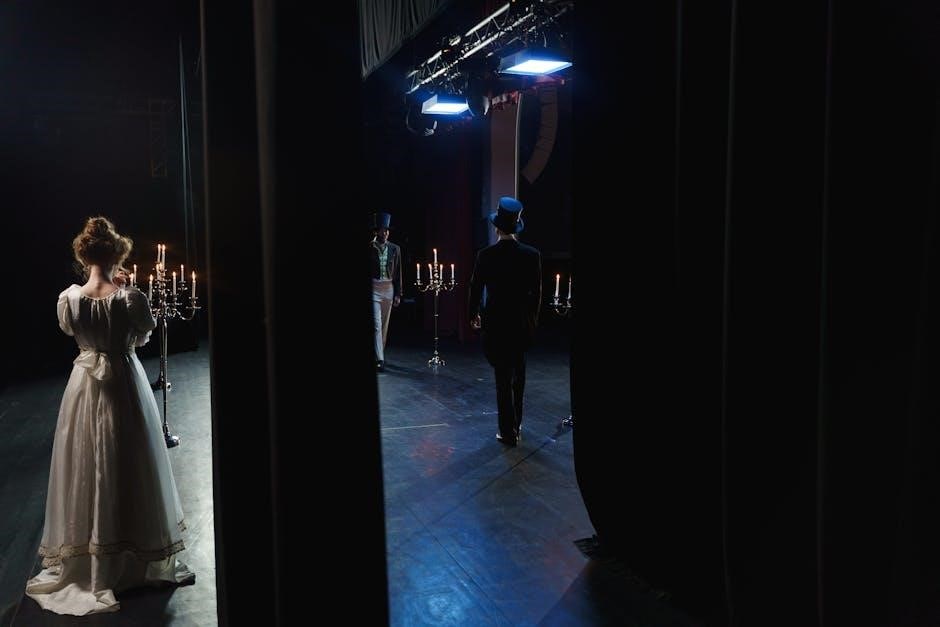
Reverend Parris’s anxieties, clearly visible in the PDF text, stem from his desire to protect his reputation and position within the community. Abigail Williams, as presented in the PDF, manipulates others to gain power and control, demonstrating the corrupting influence of ambition.
The PDF highlights how accusations of witchcraft are used as a tool to exert power over others, destroying reputations and livelihoods. John and Elizabeth Proctor’s relationship, detailed in the PDF, showcases the devastating consequences of a tarnished reputation. Analyzing the PDF reveals Miller’s exploration of how fear and paranoia can empower individuals to exploit and control those around them.
Motifs in Act 1: Possession and Confession
The PDF version of The Crucible’s Act 1 prominently introduces the motifs of possession and confession, crucial to understanding the play’s unfolding drama. The PDF text details the initial claims of the girls being “possessed,” fueling the hysteria and setting the stage for accusations.
Analyzing the PDF reveals how confession becomes a central mechanism for survival, as characters are pressured to admit to false accusations to avoid harsher punishments. Tituba’s coerced confession, readily available in the PDF, exemplifies this dynamic, demonstrating the power of manipulation and fear.

The PDF showcases how these motifs intertwine, with accusations of possession leading to demands for confession, and confessions reinforcing the belief in demonic influence. Miller, through the PDF’s narrative, explores the psychological impact of these pressures, highlighting the vulnerability of individuals facing societal and religious persecution. The PDF allows for close examination of the language used surrounding these motifs, revealing their manipulative power.
The Crucible: A Test of Character
The readily accessible PDF of The Crucible’s Act 1 immediately establishes the play’s central theme: a rigorous test of individual character under immense pressure. The PDF reveals how the unfolding events in Salem serve as a crucible, exposing the moral fiber – or lack thereof – in its inhabitants.
Through the PDF, we witness characters like John Proctor grappling with past transgressions and facing a crisis of conscience. The PDF’s text highlights the choices individuals make when confronted with accusations, fear, and the threat of societal condemnation.
Analyzing the PDF demonstrates how Miller uses the Salem witch trials to explore universal themes of integrity, courage, and the consequences of compromise. The PDF allows readers to closely examine the characters’ responses to adversity, revealing their true natures. The PDF format facilitates a detailed study of how each character is “tested” and whether they succumb to hysteria or uphold their principles.
Analyzing the Court Proceedings in Act 1
The PDF version of The Crucible’s Act 1 provides a crucial foundation for analyzing the nascent court proceedings and the manipulative tactics employed. Examining the text within the PDF reveals the initial interrogations, particularly those involving Reverend Parris, Thomas Putnam, and Tituba, showcasing a clear power dynamic and coercive questioning.
The PDF highlights how accusations are initially vague and fueled by fear and superstition. The PDF’s text demonstrates the pressure exerted on Tituba, ultimately leading to her confession and the naming of others – a pivotal moment illustrating the dangers of forced confessions.
Through careful study of the PDF, one can dissect the lack of due process and the reliance on spectral evidence. The PDF allows for a detailed examination of the language used, revealing the biases and prejudices that underpin the proceedings. The PDF format enables a focused analysis of how the court, even in its early stages, becomes a tool for settling personal scores and reinforcing existing societal hierarchies.
The PDF Format and Accessibility of Act 1 Text
The widespread availability of The Crucible Act 1 in PDF format significantly enhances its accessibility for students, educators, and literary enthusiasts. This digital format allows for convenient download, storage, and portability, facilitating study across various devices. The PDF version often includes features like searchable text, enabling quick reference to specific lines and passages.
Furthermore, the PDF format supports annotation, allowing readers to highlight key quotes, add notes, and engage directly with the text. Many PDF versions are optimized for screen readers, improving accessibility for visually impaired individuals. The consistent formatting of the PDF ensures that the text appears as intended, preserving Miller’s original staging cues and dialogue structure.
Access to the PDF also promotes collaborative learning, as students can easily share and discuss the text. The PDF’s ease of distribution makes it a valuable resource for classroom assignments and independent study, fostering a deeper understanding of this seminal work of American drama.